Striatolamia striata
Striatolamia striata
Representative Specimens
Selected reference specimens illustrating this species from different geological units and fossil sites.
Identification Examples
Choose a fossil site to view photographed reference specimens.
Summary
Striatolamia striata was a sand-tiger-type lamniform shark with a slender grasping dentition. It belonged to a successful Palaeogene radiation of predatory sharks that hunted mobile prey in warm marine environments.
Its tall pointed teeth were designed to pierce and retain rather than crush. Fishes were probably the principal prey, while cephalopods and other soft-bodied animals may also have been taken. The fine ridging on many teeth reflects crown construction but does not change the overall grasping function of the dentition.
The species is known chiefly from isolated teeth, leaving its precise body form uncertain. Those teeth nevertheless indicate an active mid-level predator occupying an important place in early Eocene marine food webs.
Quick Identification
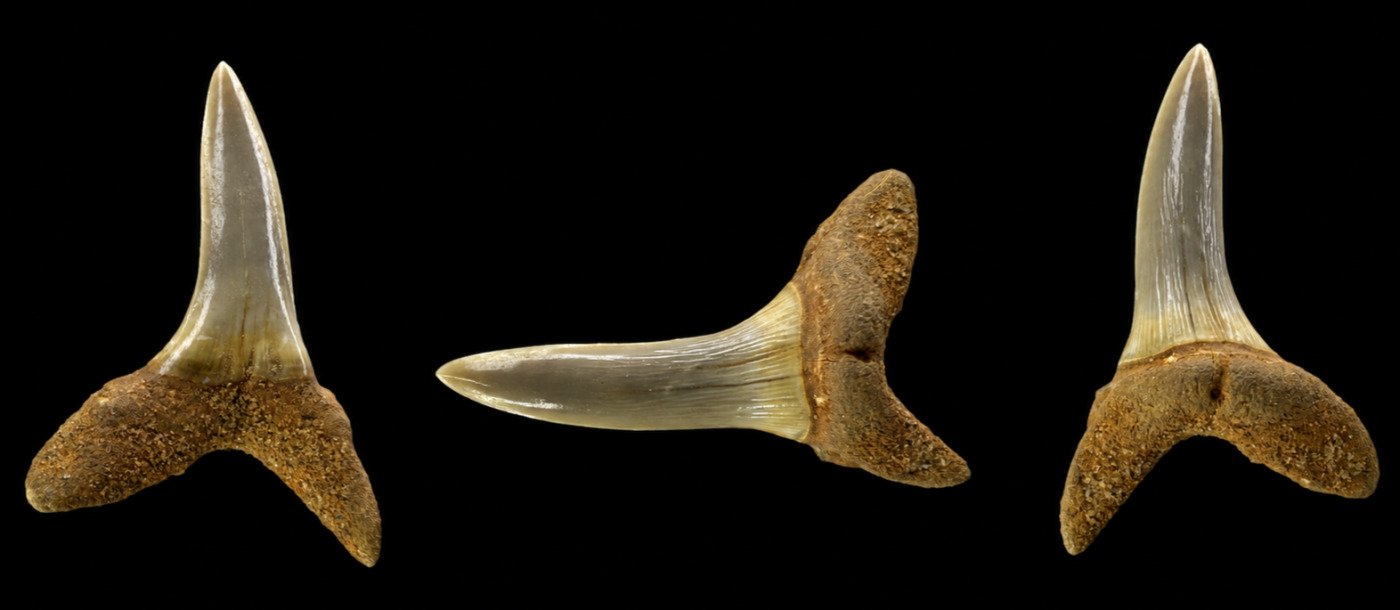
Look for: a slender sand-tiger tooth with a tall central cusp, small lateral cusplets and conspicuous longitudinal striations on the lingual crown face; compare the extent and strength of striation with Striatolamia macrota.
Diagnostic Features
- Lingual crown face carries pronounced longitudinal striations.
- Main cusp is tall, narrow and unserrated.
- Lateral cusplets are small and pointed on complete teeth.
- Root is bilobed with a deep central division.
- Crown ornament is a primary discriminator from less strongly striated odontaspidid teeth.
Fossil Details
Similar Species
Recorded Fossil Sites
Beltinge Fish Bed
Lessness Shell Bed
Reculver Sand Member
Synonyms & Previous Names
References
- Dineley, D. & Metcalf, S. (1999). Fossil Fishes of Great Britain. Geological Conservation Review Series, 675 pp.. Joint Nature Conservation Committee, Peterborough View reference
- Rayner, D.; Mitchell, T.; Rayner, M. (2009). London Clay Fossils of Kent and Essex. 228 pp.. Medway Fossil and Mineral Society, Rochester, Kent View reference
- Ward, D.J. (1978). The Lower London Tertiary (Palaeocene) succession of Herne Bay, Kent. Report of the Institute of Geological Sciences. Institute of Geological Sciences View reference
- Ward, D.J. (1980). The distribution of sharks, rays and chimaeroids in the English Palaeogene. Tertiary Research, 3(1), 13–19 View reference