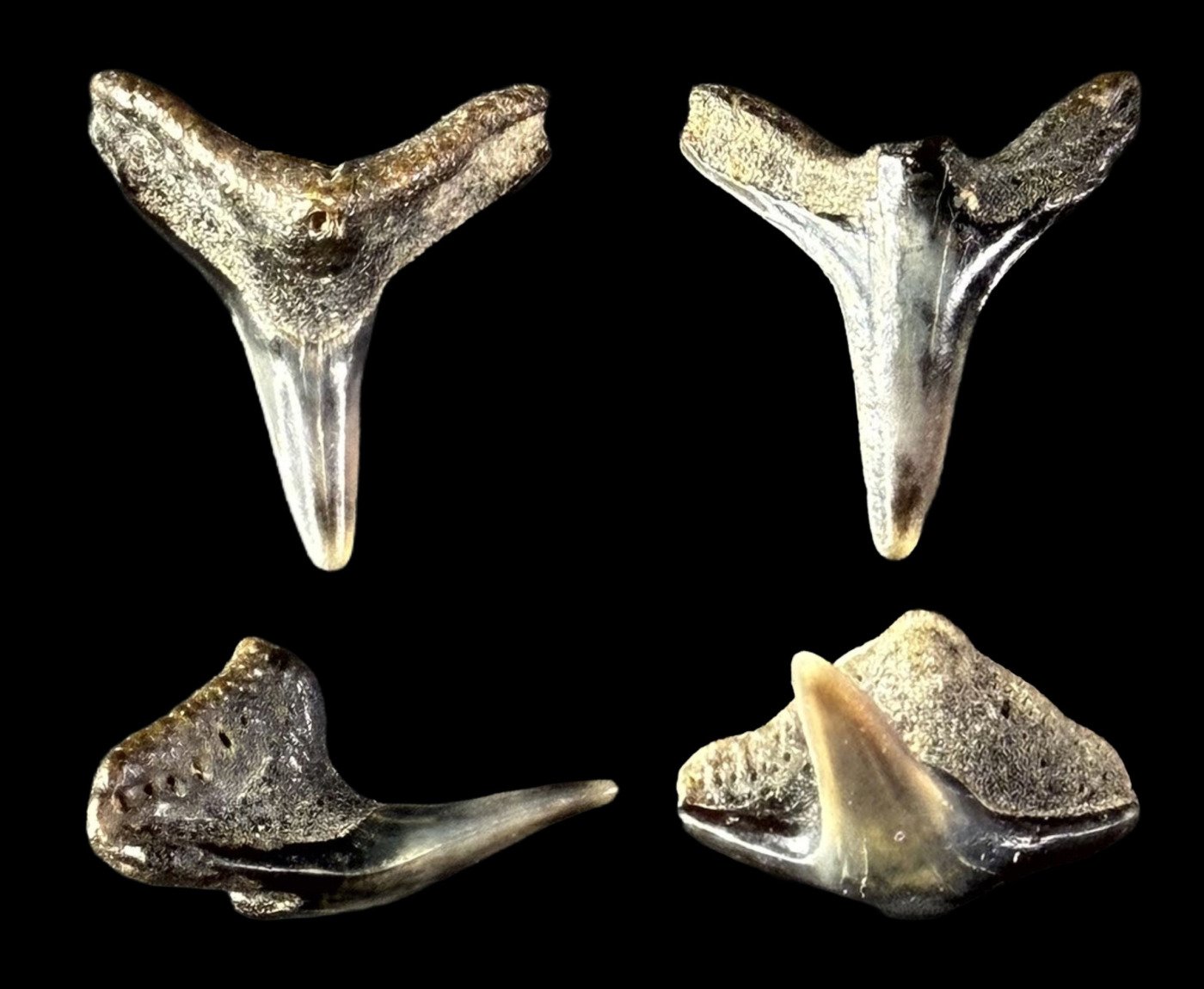
Squatina prima
Squatina prima
Common Name: Angel Shark
Order: Squatiniformes.
Family: Squatinidae
Genus: Squatina
Summary
Squatina prima is an extinct species of angel shark, known mainly from its small, distinctive teeth. Like living angel sharks, it was a flattened, bottom-dwelling predator that probably spent much of its time resting on or partly buried within the seabed, feeding on small fish and other marine animals.
Its teeth are typically small and broad, with a single narrow central point, low shoulders on either side and a wide root. They have smooth cutting edges and no serrations or separate side cusplets.
Teeth attributed to Squatina prima are known from Palaeocene and Eocene deposits, including several important sites within the London Basin such as Abbey Wood, Beltinge and the London Clay Formation.
Angel shark teeth changed relatively little through geological time, meaning that isolated fossil teeth can be difficult to identify to species with complete certainty. Well-preserved, slender teeth from appropriate Palaeogene deposits are commonly identified as Squatina prima, while incomplete or unusual specimens may be better recorded simply as Squatina sp.
Geological Age & Range Notes
Selandian, Middle Palaeocene, Orp Sand Member, Heers Formation, Orp-le-Grand, Belgium. Traditional S. prima sensu lato range: approximately Selandian to Late Eocene.
Representative Specimens
Selected reference specimens illustrating this species from different geological units and localities.
Identification Examples
Choose a locality to view photographed reference specimens.
Known Localities
Diagnostic Features
-
- Teeth are usually small and noticeably wider than they are tall.
- The centre of the tooth forms a single narrow, pointed cusp. This is usually quite tall and slender rather than thick or bulky.
- The main cusp has no small side cusplets. Instead, the crown spreads out to either side as broad, low shoulders.
- These shoulders are usually fairly straight or gently curved, giving the tooth a distinctive broad, almost wing-shaped appearance beneath the central point.
- The cutting edge is smooth, with no serrations, and continues from the main point along the shoulders on either side.
- Both sides of the crown are generally smooth and free from strong grooves or decoration.
- Viewed from the front, there is usually a small rounded projection of enamel underneath the centre of the crown. This can look like a small knob or tongue pointing down towards the root and is a useful feature of angel shark teeth.
- The root is very broad compared with the crown. When viewed from underneath it is roughly triangular or diamond-shaped, often with rounded corners.
- The underside of the root is fairly flat and usually has a central hollow or depression, with small openings through which blood vessels and nerves originally entered the tooth.
- Front teeth tend to have a straight, upright central point and a fairly symmetrical shape.
- Teeth from farther around the side of the jaw become more uneven in shape, with the central point leaning slightly towards one side.
- Squatina prima is generally characterised by a slender, delicate-looking crown and relatively low shoulders rather than the thicker, heavier appearance seen in some other fossil angel sharks.
Identification Notes
Squatina prima has one of the more distinctive general tooth shapes among the sharks found in London Basin deposits.
A typical tooth looks like a small pointed triangle sitting in the middle of a much wider base. There are no separate little side points. Instead, the crown runs outwards on both sides of the main point to form low shoulders.
One of the easiest features to look for is therefore the combination of:
a narrow central point + broad low shoulders + smooth cutting edges + a broad triangular or diamond-shaped root.
Looking at the tooth from several directions is particularly useful. From the front, concentrate on the shape of the central point and shoulders. From underneath, the broad triangular or diamond-shaped root is often extremely characteristic.
There is also commonly a small rounded piece of enamel projecting downwards in the centre of the front of the tooth. This feature is typical of Squatina teeth and can help separate them from small teeth belonging to other sharks.
The shape changes depending on where the tooth came from in the mouth. Teeth near the front are usually more upright and symmetrical. Teeth farther around the side of the jaw become broader and the point may lean sideways. For this reason, two genuine Squatina teeth from the same shark can look noticeably different.
References & Literature
Winkler, T.C. (1874), Mémoire sur quelques restes de poissons du système heersien, Archives du Musée Teyler 4(1): 1–15. The original description, under Trigonodus primus, based on teeth from the Heersian sands of Orp-le-Grand. It establishes the slender curved cone, unusual broad triangular root and basal depression and remains the nomenclatural starting point. Shark-References provides the bibliographic entry and original figures 18–21. Language: French; indispensable primary source. [1]
Leriche, M. (1905), Belgian Palaeocene fish monograph. An important early revision because Leriche noted that Winkler’s original illustrations had conveyed the morphology poorly and redescribed the teeth as substantially more slender, with a straight to slightly inclined crown, sharp lateral crown bands and a broad low root excavated basally. This treatment helped stabilise the subsequent Squatina interpretation. Language: French; primary historical revision. [11]
White, E.I. (1931), The Vertebrate Faunas of the English Eocene. I. From the Thanet Sands to the Basement Bed of the London Clay. British Museum (Natural History). A foundational museum monograph for British early Palaeogene vertebrates and a principal source for the historical English concept of S. prima and its stratigraphic distribution. It remains especially relevant to Thanet–Beltinge–pre-London-Clay specimens. Language: English; high-priority British museum source. [9]
Casier, E. (1966), Faune ichthyologique du London Clay. British Museum (Natural History), London. The major historical museum treatment of London Clay fishes and a fundamental source for Squatina material from the formation. Casier’s attribution of two Sheppey neurocrania to S. prima was later regarded as unconfirmed by Klug & Kriwet, so the work is important both taxonomically and as an example of subsequent revision. French text, British Museum publication. [3]
Ward, D.J. and associated British Palaeogene studies, especially the 1970s–1980s stratigraphic work. These underpin much of the detailed British distribution used by the JNCC Geological Conservation Review, particularly the successive fish assemblages at Herne Bay and the use of teeth for Lower Tertiary correlation. English; important for locality and stratigraphic identification. [9]
Kemp, D.J., Kemp, L. & Ward, D.J. (1990), An Illustrated Guide to the British Middle Eocene Vertebrates. The JNCC Sheppey account reproduces its comparison of S. prima lateral and anterior teeth, making it one of the most useful accessible positional illustrations for British material. [3]
Klug, S. & Kriwet, J. (2013), “Node age estimates and the origin of angel sharks, Squatiniformes (Neoselachii, Squalomorphii)”. A modern systematic treatment of angel sharks. Particularly relevant here because it outlines stable Squatina-level dental architecture and reports that the two London Clay neurocrania formerly assigned to S. prima could not be conclusively identified. Peer-reviewed, English. [8]
Carlsen, A.W. & Cuny, G. (2014), A study of the sharks and rays from the Lillebælt Clay (Early–Middle Eocene) of Denmark, and their palaeoecology. Bulletin of the Geological Society of Denmark. One of the clearest English-language comparative discussions for fossil Squatina teeth. It identifies the triangular root, rounded apron, long sharp-edged heels and triangular crown as generic characters, defines traditional S. prima as slender-crowned and low-shouldered, and explicitly warns that isolated teeth are difficult to identify to species. Peer-reviewed/academic, English; highly useful for identification. [5]
Jambura, P.L. et al. (2020), “Evolutionary trajectories of tooth histology patterns in modern sharks (Chondrichthyes, Elasmobranchii)”. Journal of Anatomy. Includes micro-CT/virtual sections of a fossil S. prima tooth and documents its internal dental tissues. Less useful for hand-specimen identification but valuable when histology or micro-CT material is available. Peer-reviewed, English. [6]
Rodríguez, D., Ward, D.J. & Quezada, J.A. (2023), “Paleontology and stratigraphic implications of a late Paleocene elasmobranch assemblage in Talcahuano, southcentral Chile”. Andean Geology 50(2): 217–247. Exceptionally useful for modern identification because it gives a concise tooth description, documents a real abrasion-induced misidentification, discusses size and anterior curvature, and argues that S. prima sensu lato probably includes several species. It also argues that S. crassa falls within the early robust variation of S. prima. Peer-reviewed, English-language systematic discussion. [2]
De Schutter, P.J. & Steurbaut, E. (2025), “Taxonomic revision and new elasmobranch records from the Wemmel Sand and Asse Clay members, base of the Maldegem Formation (middle Lutetian, southern North Sea Basin)”. Geologica Belgica 28: 117–131. The most relevant recent revision located. It stresses the conservative nature of squatinid teeth, uses S. cf. prima for uncertain material and, unlike Rodríguez et al., recognises a morphological distinction between slender S. prima and smaller, more robust, thick-rooted S. crassa. This disagreement should be preserved explicitly in database notes rather than silently choosing one interpretation. Peer-reviewed, English. [4]
JNCC, Fossil Fishes of Great Britain — Sheppey and Herne Bay site accounts. These are particularly useful official British locality sources. The Sheppey account illustrates lateral and anterior S. prima, documents its London Clay presence and taphonomy, and the Herne Bay account records the species bed-by-bed through the Thanet Formation, Beltinge Fish Bed, Oldhaven beds and basal London Clay. [3]
British Geological Survey Lexicon. The BGS currently assigns the London Clay Formation to the Ypresian and the Blackheath Member at Abbey Wood to the early Ypresian, providing the preferred modern stratigraphic framework for British database records. [10]
Tertiary Research Group, Abbey Wood Fossils. Provides scans of real Abbey Wood S. prima teeth and vertebrae with scale bars, and is therefore one of the most immediately useful image resources for matching specimens from that site. Its approximate absolute date should be secondary to the current BGS lithostratigraphic assignment. [7]
Shark-References, Squatina prima species page, version 08/2026. The strongest current one-page taxonomic resource located: accepted combination, original citation and figures, synonymic history, type-catalogue connections, a Lutetian specimen photograph and an extensive bibliography including Burnham-on-Crouch, Sheppey, Belgium, France, Denmark, North America, Asia, Africa and South America. Its synonym list is best treated as a bibliographic/taxonomic history rather than evidence that every listed nominal species is universally accepted as synonymous. [1]