Mithracia libinioides
Mithracia libinioides
Representative Specimens
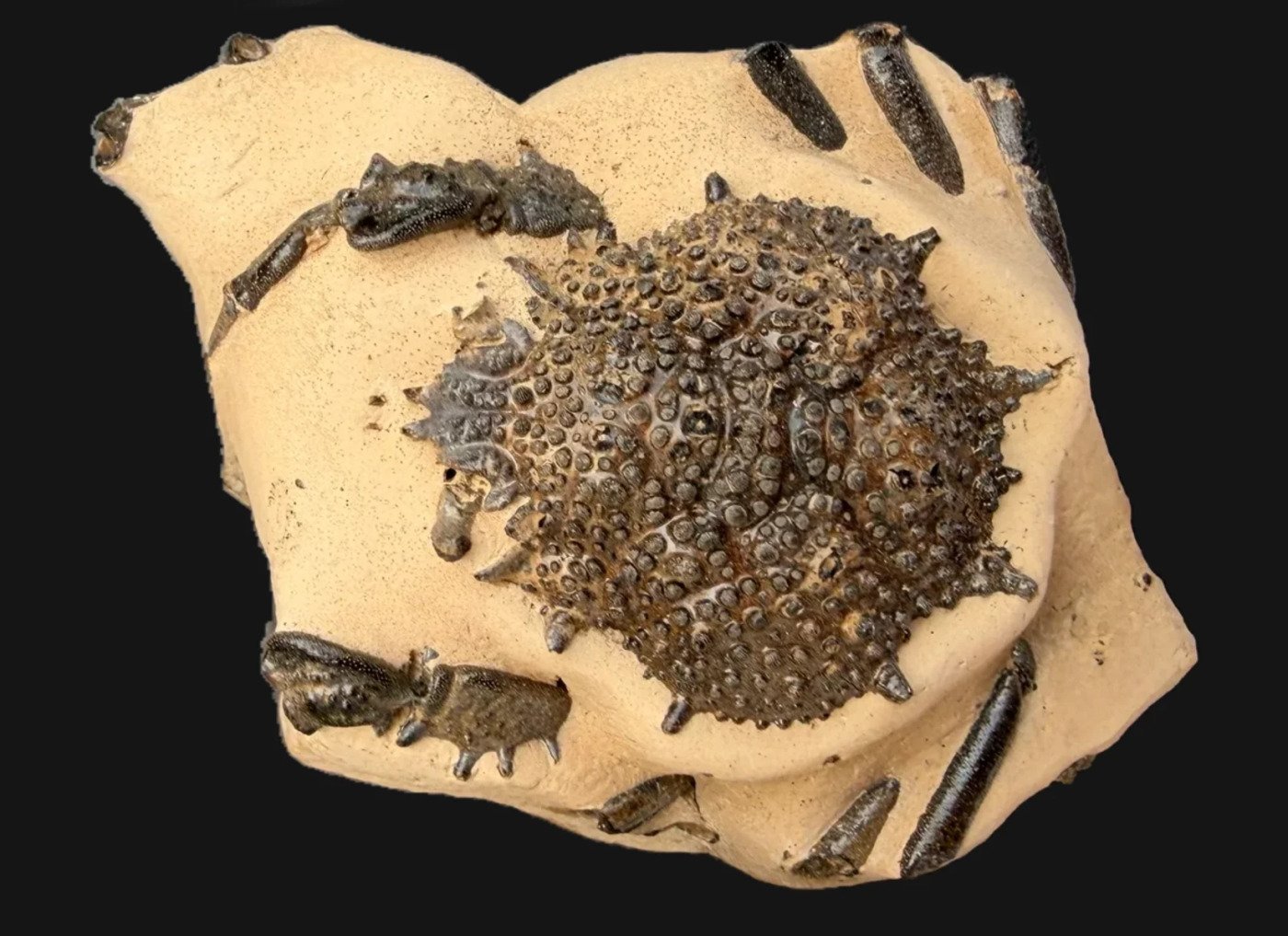
Selected reference specimens illustrating this species from different geological units and fossil sites.
Identification Examples
Choose a fossil site to view photographed reference specimens.
Summary
Mithracia libinioides was a spider crab, part of a group famous today for long legs and remarkable camouflage. Many living spider crabs deliberately attach algae, sponges and other material to hooked hairs on the body, helping them blend into the seabed.
A London Clay spider crab would probably have moved slowly over the bottom, feeding on small animals, carrion and organic material while relying on camouflage rather than speed. That lifestyle makes spider crabs especially appealing examples of behaviour that may have deep evolutionary roots.
Quick Identification
Look for: a compact ornamented spider-crab carapace with majoid proportions, a differentiated frontal region and well-defined dorsal areas; incomplete central fragments should be treated cautiously.
Diagnostic Features
- Carapace compact and majoid in overall form.
- Dorsal surface carries distinct ornament rather than being uniformly smooth.
- Frontal region is differentiated from the rounded lateral margins.
- Regional grooves and swellings form a consistent spider-crab pattern.
- Species-level identification is strongest when the front, margins and dorsal ornament are preserved together.
Fossil Details
Similar Species
Recorded Fossil Sites
London Clay Formation
References
- J. S. H. Collins; C. J. T. Mellish; A. J. Ross; P. R. Crabb; S. K. Donovan. (2020). A guide to the fossil Decapoda (Crustacea: Axiidea, Anomura, Brachyura) of the British Isles. Proceedings of the Geologists' Association, 131(1), 19–50 View reference
- Thomas Bell. (1857). A monograph of the fossil malacostracous Crustacea of Great Britain. Part I. Crustacea of the London Clay. Monograph of the Palaeontographical Society, 10, i–viii, 1–44. Palaeontographical Society, London View reference