Isselicrinus subbasaltiformis
Isselicrinus subbasaltiformis
Representative Specimens
Selected reference specimens illustrating this species from different geological units and fossil sites.
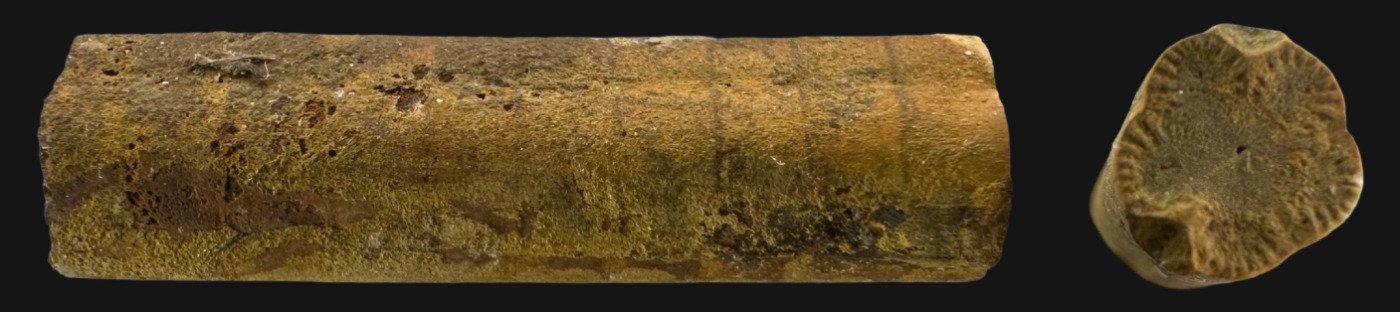
Identification Examples
Choose a fossil site to view photographed reference specimens.
Summary
Isselicrinus subbasaltiformis was a stalked isocrinid sea lily that formed part of the suspension-feeding community above the London Clay sea floor. A long jointed stem supported a crown of feathery arms, allowing the animal to intercept suspended food particles in bottom currents.
The species is especially well known from stem material, and its restricted abundance at some London Clay levels has long been used stratigraphically. Fossil remains are therefore commonly columnals and stem fragments rather than complete crowns, giving a strong record of attachment and feeding posture but only rare views of the whole animal.
Quick Identification
Look for: stacked crinoid columnals from a stalked sea lily, with a central lumen and strongly patterned articular faces; compare columnal outline and facet pattern carefully because several London Clay crinoids produce superficially similar stem fragments.
Diagnostic Features
- Stem consists of robust isocrinid columnals with well-developed articular facets.
- Columnal articular faces carry a radial crenular pattern around the central lumen.
- Columnal outline and lumen geometry are consistent through associated stem segments.
- Short articulated stem pieces may retain nodal/internodal differentiation typical of isocrinids.
- Secure species identification depends on well-preserved facet morphology and stratigraphic context, not merely a crinoid disc shape.
Fossil Details
Similar Species
Recorded Fossil Sites
London Clay Formation
References
- Roux, M.; Martinez, A.; Vizcaïno, D. (2021). A diverse crinoid fauna (Echinodermata, Crinoidea) from the Lower Eocene of the Gulf of Languedoc (Corbières, Aude, southern France). Zootaxa, 4963(2), 201–242 View reference