Deltoidonautilus sowerbyi
Deltoidonautilus sowerbyi
Representative Specimens
Selected reference specimens illustrating this species from different geological units and fossil sites.
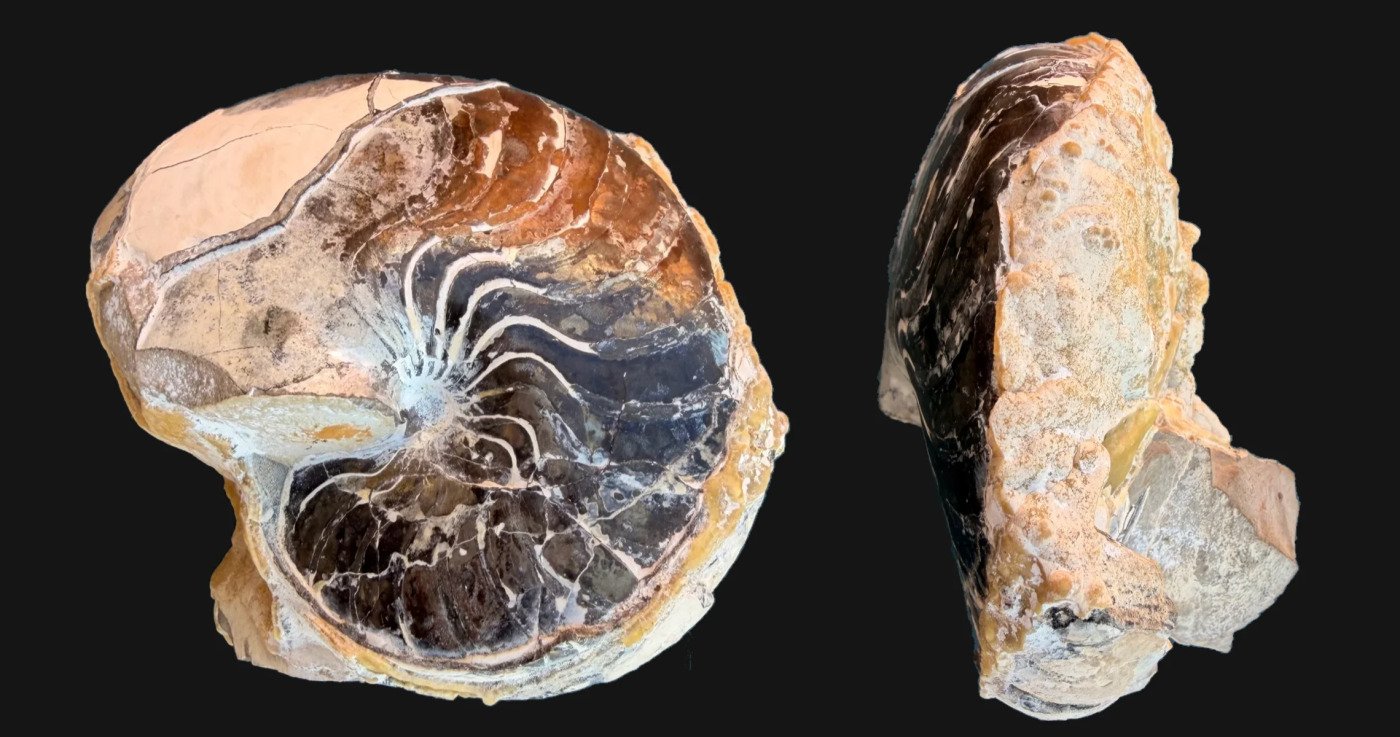
Identification Examples
Choose a fossil site to view photographed reference specimens.
Summary
Deltoidonautilus sowerbyi was a streamlined chambered cephalopod that swam in the London Clay sea. Its tightly coiled shell acted as a buoyancy device, while the living animal occupied the final body chamber and used jet propulsion to move and manoeuvre through the water.
Like other nautiloids it was probably an opportunistic predator and scavenger, taking crustaceans, other small marine animals and carrion. Its comparatively narrow outer shell profile distinguishes it from the broader D. cassinianus and shows that several differently shaped nautiloids shared the same early Eocene seas.
Quick Identification
Look for: an involute Deltoidonautilus with a narrow to subangular outer profile, slightly convex flanks, a very small umbilicus and simple gently undulating sutures.
Diagnostic Features
- Shell is planispiral, strongly involute and relatively streamlined.
- Flanks are slightly convex and converge towards a narrow or subangular venter.
- Umbilicus is very small because earlier whorls are strongly enclosed.
- Septal sutures are simple and gently undulating rather than strongly zig-zag.
- Outer shell profile is narrower and more peaked than the broad rounded whorl of Deltoidonautilus cassinianus.
Fossil Details
Similar Species
Recorded Fossil Sites
London Clay Formation
Synonyms & Previous Names
References
- Edwards, F. E. (1849). A monograph of the Eocene Mollusca, or descriptions of shells from the older Tertiaries of England. Part I. Cephalopoda. Palaeontographical Society Monograph, 2, 1–56. Palaeontographical Society, London View reference
- Hewitt, R. A. (2002). A review of the Early Eocene nautiloids of the London Clay Formation (upper division C to lowest division E) of south-east England, with particular reference to concretionary horizons and faunules in the offshore facies strata at Southend-on-Sea, Essex and in the adjacent cliffs of the Isle of Sheppey, Kent. Tertiary Research, 21(1–4), 39–50 View reference