Eocoelopoma curvatum
Eocoelopoma curvatum
Representative Specimens
Selected reference specimens illustrating this species from different geological units and fossil sites.
Identification Examples
Choose a fossil site to view photographed reference specimens.
Summary
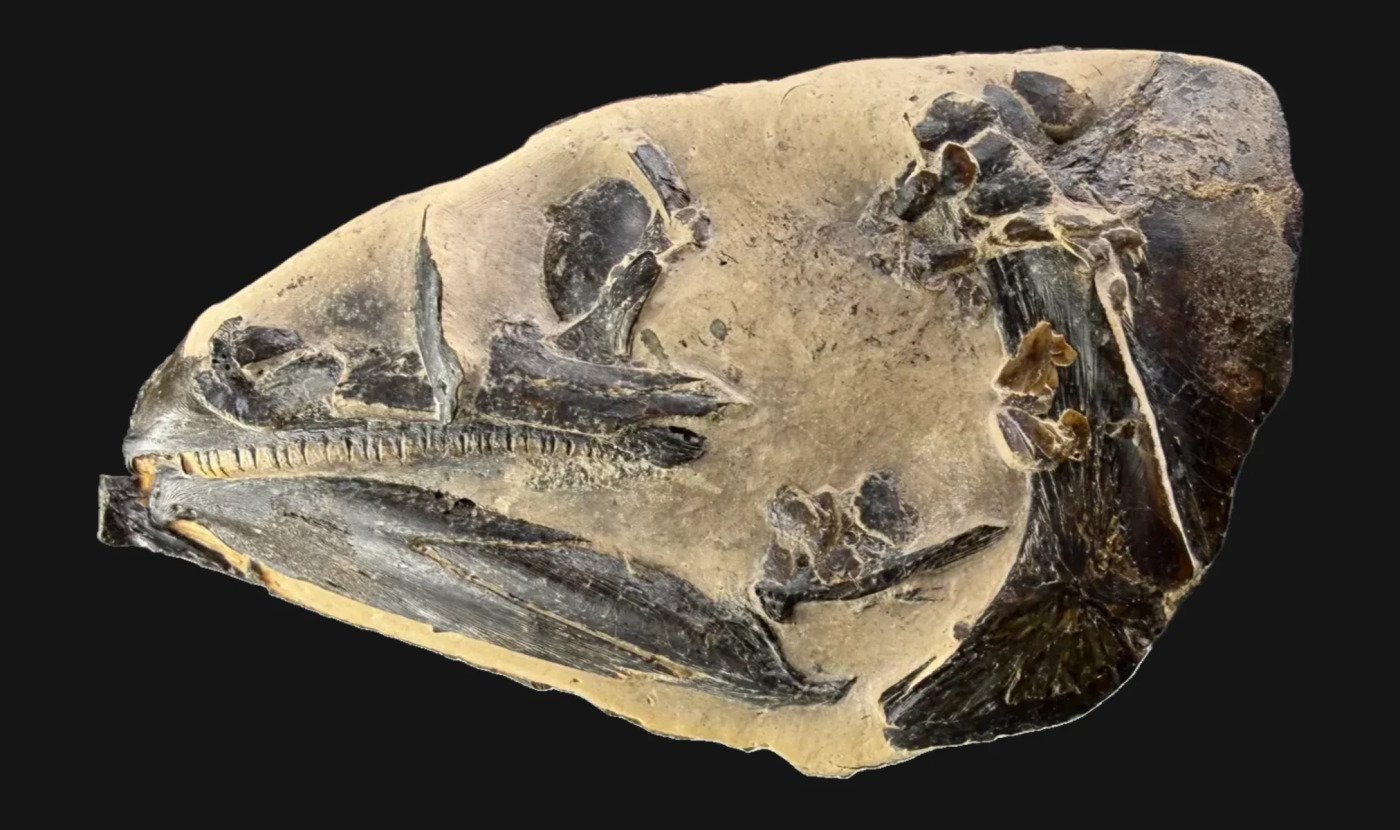
Eocoelopoma curvatum was a more elongate-headed member of the London Clay scombrid radiation. Its jaws carried slender, sharp teeth, indicating a grasping predator of fishes or other soft-bodied nekton. The large ossified eye structures and streamlined cranial proportions suggest an active, visually oriented marine fish, although swimming behaviour cannot be reconstructed directly from the skull alone.
Three-dimensional specimens show fine curved ornament on the frontal bones and a specialised fossa beside the orbit. Compared with the compact head of some congeners, the skull is noticeably longer relative to its width, giving E. curvatum a distinctive cranial profile within this early mackerel-like assemblage.
Quick Identification
Look for: an elongate scombrid skull about one and two-thirds times longer than wide, with fine curved-line ornament on the frontals, bluntly rounded anterior frontals, large sclerotic ossicles and slender sharp jaw teeth.
Diagnostic Features
- Skull is elongate, approximately 1.7 times longer than wide.
- Frontal bones anterior to the orbital fossa are densely ornamented with fine curved lines.
- Anterior ends of the frontals are blunt to rounded rather than pointed.
- Jaw teeth are slender, elongate and sharply pointed.
- Sclerotic ossicles are large and strongly developed around the orbit.
Fossil Details
Recorded Fossil Sites
London Clay Formation
References
- Casier, E. (1966). Faune ichthyologique du London Clay. 496 pp.. Trustees of the British Museum (Natural History), London View reference
- Friedman, M.; Beckett, H. T.; Close, R. A.; Johanson, Z. (2016). The English Chalk and London Clay: two remarkable British bony fish Lagerstätten. Geological Society, London, Special Publications, 430(1), 165–200. Geological Society of London, London View reference
- Monsch, K. A. (2005). Revision of the scombroid fishes from the Cenozoic of England. Transactions of the Royal Society of Edinburgh: Earth Sciences, 95(3–4), 445–489 View reference