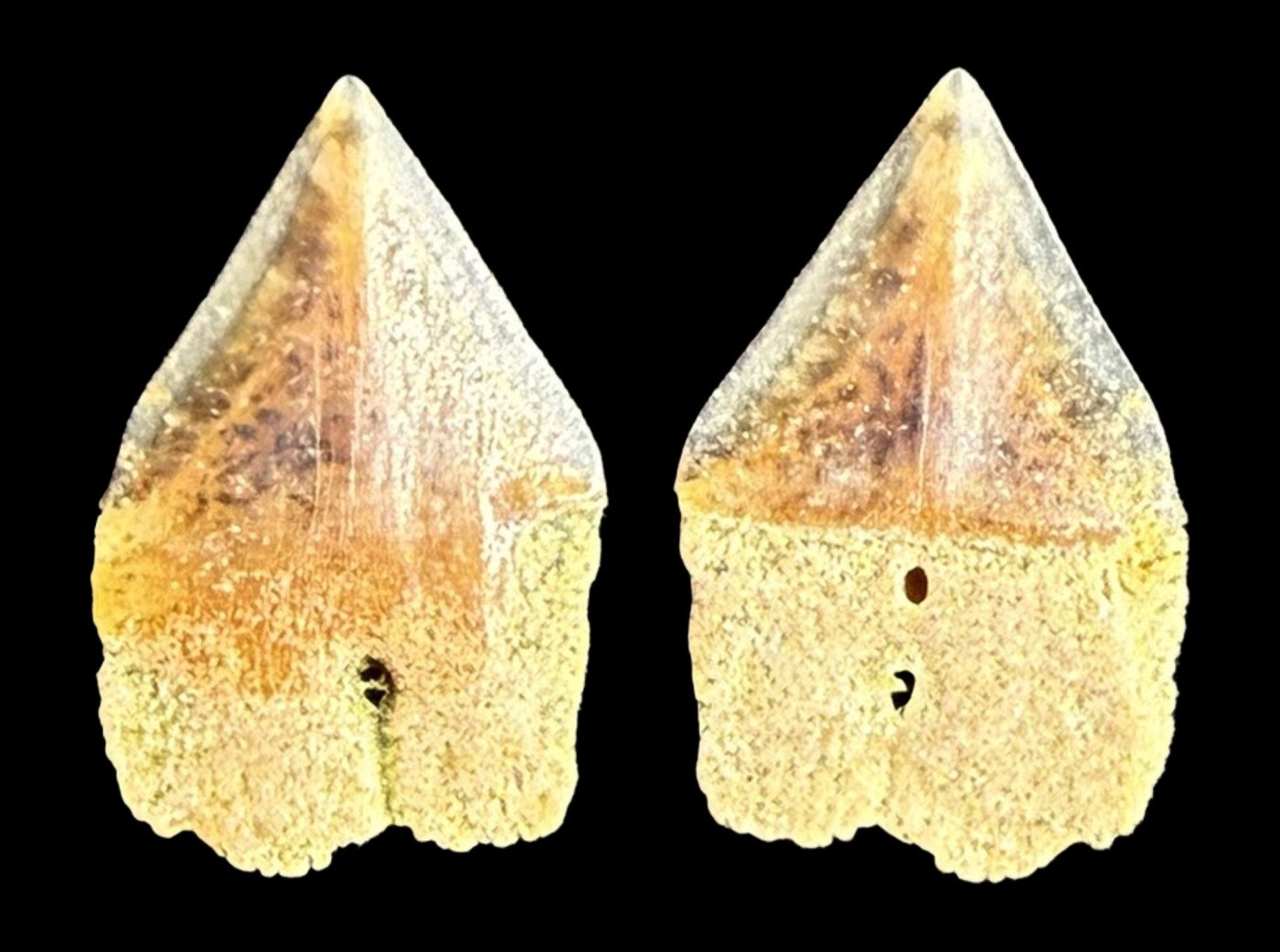
Isistius trituratus

Isistius trituratus

Winkler, 1874

Common Name: Cookiecutter Shark

Fossil Group: Sharks & Rays
Order: Squaliformes
Family: Dalatiidae
Genus: Isistius

Summary

Isistius trituratus is an extinct species of cookiecutter shark known from Palaeocene and Eocene marine deposits. Like living cookiecutter sharks, it had highly specialised teeth, with the lower jaw forming a continuous cutting edge that could remove pieces of flesh from larger marine animals.

Its fossil lower teeth are particularly distinctive. They are small, broad and triangular, with a very thin blade-like shape, smooth cutting edges and no side cusplets. The roots are relatively deep and shaped so that neighbouring teeth could fit closely together.

Isistius trituratus is known from the Early Eocene London Clay Formation, including sites in Essex and Kent. Its teeth are usually only a few millimetres in size and can easily be overlooked when collecting or processing fine material.

It is most easily recognised by the combination of a tiny triangular blade, smooth unserrated edges and a deep flat root. Similar younger species exist, so the geological age and locality are also useful when confirming an identification.

Geological Age & Range Notes

Late Palaeocene to Eocene, with Isistius trituratus particularly well recorded from Early and Middle Eocene deposits. Records extend from the Thanetian through the Ypresian, Lutetian and into the Bartonian

Fossil Material

Tooth

Known Localities

Diagnostic Features

  • The teeth most commonly found as fossils are from the lower jaw. These look completely different from the tiny upper teeth of cookiecutter sharks.
  • A typical tooth is small, broad and triangular, rather like a miniature cutting blade.
  • The central point forms a simple triangle rather than a long narrow spike.
  • Well positioned front teeth are usually almost symmetrical, with the point sitting directly above the centre of the tooth.
  • Teeth from farther around the jaw can become slightly uneven, with the point leaning towards one side.
  • The tooth is very thin from front to back. Viewed from the side it looks more like a thin blade than the thick tooth of many other sharks.
  • The two cutting edges running down either side of the triangular crown are smooth and have no obvious serrations. This is one of the most useful features of I. trituratus.
  • There are no small side points or cusplets beside the main crown.
  • The surface of the crown is normally smooth, without the vertical lines, folds or heavy decoration seen on some other fossil shark teeth.
  • The crown is often roughly as wide as it is high, although its proportions change slightly depending on where it came from in the jaw.
  • Below the crown is a flat, relatively deep root.
  • A groove or opening runs through the middle of the root, forming part of the channel that originally supplied the tooth. On complete specimens this can be a useful additional feature.
  • The edges of the root are shaped so that neighbouring lower teeth could fit closely together, producing a continuous cutting surface in the living shark.
  • Complete teeth are normally only a few millimetres in size. Fossil lower crowns described from Eocene material range from around 1 mm to several millimetres high.

Identification Notes

Isistius trituratus is the extinct Palaeogene cookiecutter shark and has a particularly distinctive lower tooth.

A good specimen should look like a tiny triangular cutting blade rather than the more familiar pointed shark tooth.

The easiest combination of features to look for is:

small tooth + broad triangular crown + very thin blade-like shape + smooth cutting edges + no side points + deep flat root.

Look at the overall shape

The lower teeth are very different from the long pointed teeth of sharks such as Striatolamia.

Instead of having a narrow central point sitting above a root, almost the entire crown forms one broad triangle.

The two sides of that triangle form the cutting edges.

This shape allowed neighbouring teeth to sit closely together and form a continuous cutting row, similar to the lower teeth of living cookiecutter sharks.

Check the cutting edges

This is particularly important.

In Isistius trituratus the sides of the crown should normally be:

smooth — not serrated.

This helps distinguish it from the younger fossil species Isistius triangulus, whose teeth may show extremely fine serrations or crenulations along the cutting edges.

The difference is not completely foolproof. Tooth serration within Isistius is not always strongly developed, so geological age and the rest of the tooth shape should also be considered.

Isistius trituratus vs Isistius triangulus

These two fossil species are extremely similar.

A useful general guide is:

I. trituratus

  • Palaeocene and Eocene
  • smooth cutting edges
  • typical species found in London Clay and other Palaeogene deposits

I. triangulus

  • mainly Miocene and Pliocene
  • cutting edges may have extremely fine serrations
  • generally found in substantially younger deposits

The overall tooth shape changed surprisingly little between the two species, so an isolated tooth without good locality information should be treated cautiously.

Upper and lower teeth are very different

Cookiecutter sharks have an unusual set of teeth.

The lower teeth are large, broad and triangular and form the cutting blades commonly encountered as fossils.

The upper teeth are much smaller, narrow and pointed and were used for gripping rather than cutting.

Upper teeth are exceptionally rare in the fossil record and are much harder to recognise. Only a very small number have been attributed to fossil Isistius. Therefore, nearly all isolated teeth identified as Isistius trituratus will be the distinctive triangular lower teeth.

Broken specimens

The root is often the first part of the tooth to be damaged.

A specimen consisting only of the triangular crown can still be a good Isistius candidate if it shows:

  • a thin triangular blade
  • approximately symmetrical shape
  • smooth cutting edges
  • no side points
  • no strong surface decoration

However, identifying an incomplete crown specifically as I. trituratus rather than simply Isistius should also take the age and locality into account.

London Clay identification

For London Clay specimens, Isistius trituratus is the expected species of Isistius. It is recorded from the English Early Eocene and is specifically documented from London Clay localities including Burnham-on-Crouch.

A complete London Clay tooth showing the characteristic smooth-sided triangular blade and appropriate root structure can therefore be confidently considered I. trituratus.

If only a badly damaged triangular crown survives, Isistius cf. trituratus or Isistius sp. may be more appropriate.

Quick identification

Look for:

tiny triangular blade + very thin tooth + smooth edges + no serrations + no side points + deep flat root.

The simple triangular shape and completely smooth cutting edges are the most immediately useful features.


References & Literature

  • Winkler, T.C. (1874). Deuxième mémoire sur des dents de poissons fossiles du terrain bruxellien. Archives du Musée Teyler, 4(1), 16–48. Original description as Corax trituratus.
  • Casier, E. (1961). Transformation des systèmes de fixation et de vascularisation dentaires dans l’évolution des sélaciens du sous-ordre des Squaliformes. Mémoires de l’Institut Royal des Sciences Naturelles de Belgique, 65, 1–55.
  • Casier, E. (1966). Faune ichthyologique du London Clay. British Museum (Natural History). Major reference for the fish and shark fauna of the London Clay.
  • Ward, D.J. (1980). The distribution of sharks, rays and chimaeroids in the English Palaeogene. Tertiary Research, 3(1), 13–19.
  • Cappetta, H. (2012). Chondrichthyes: Mesozoic and Cenozoic Elasmobranchii: Teeth. Handbook of Paleoichthyology, Volume 3E. Major modern reference for fossil shark tooth taxonomy.
  • Moreau, F., Dion, M. & Mathis, S. (2013). Présence des genres Xiphodolamia et Isistius (Chondrichthyes, Elasmobranchii) à l’Eocène du Bassin de Paris. Cossmanniana 15. Includes description and discussion of I. trituratus teeth and their Palaeogene distribution.
  • Goedert, J.L., Kiel, S., Thomas, E.J. & Kriwet, J. (2024). An Early Eocene fish assemblage from the Crescent Formation, Washington State. Provides a modern description and comparison of teeth referred to Isistius cf. trituratus.