
Isselicrinus subbasaltiformis
Isselicrinus subbasaltiformis
View age-specific evidence and explanation
| Age | Recorded Occurrences | Localities | Rarity |
|---|---|---|---|
| Ypresian | 6 | 6 | Not yet established |
These counts describe published LBPS Occurrence records with directly assigned, unambiguous geological-unit mappings—not specimen abundance. Records at restricted Localities and ambiguous or unsupported ages are excluded. Species-level age labels are not used as proof of an age-specific Occurrence.
Specimen-based rarity requires comparable, correctly identified physical fossils, geological provenance and publication permissions. It does not estimate your chance of finding a fossil or collecting access.
Representative Specimens
Selected reference specimens illustrating this species from different geological units and fossil sites.
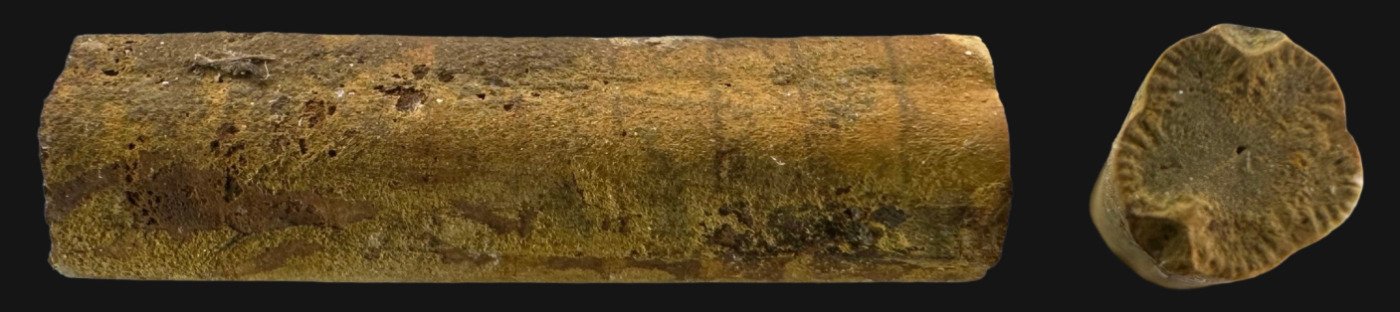
Quick Identification
What to look for
- Look for an articulated sea-lily stalk section that preserves the sequence of nodals (cirrus-bearing segments) and the intervening columnals.
- On an intact nodal, look for usually two or three cirrus attachments directed downwards, alternating in position. Long stretches of intervening stalk segments are another useful check.
- Examine both joint faces and, where available, the smooth, approximately circular outer wall of a mature columnal. Size and outline by themselves do not establish the species.
How to tell it apart
Compare with Cainocrinus tintinnabulum, which has five outward-facing cirrus sockets on a diagnostic nodal rather than the usually two or three downward-directed, alternating attachments described in Isselicrinus. The preserved nodal sequence is more useful than one loose disc.
Be careful
Even a well-shaped isolated columnal may lack enough information for species-level identification. Prefer a nodal-bearing stalk section with intact joint faces, or associated material that establishes where the elements belonged.
Identification Examples
Choose a fossil site to view photographed reference specimens.
Summary
Most fossils of Isselicrinus subbasaltiformis give little impression of the complete animal. A handful of small discs, or a short length of jointed stem, may be all that remains of a sea lily which once raised a crown of feathery arms above the Eocene seabed.
Like living stalked sea lilies, it probably used those arms to gather tiny food particles carried through the water. Its long stalk was assembled from numerous separate pieces, some bearing attachment structures, and these could break apart after death. That is why collectors are far more likely to encounter parts of the stem than the animal’s feeding crown.
But I. subbasaltiformis has an extraordinary place in the fossil record. It is the only recognised species of Isselicrinus for which complete crowns have been documented. Those exceptional fossils help reveal the arrangement of the upper body and feeding arms, giving researchers a much fuller picture of an animal usually represented by scattered stem fragments.
The species also played a part in understanding the London Clay itself. Its fossil remains occur in particular parts of the formation, and geologists have used their distribution to help recognise and correlate layers of ancient marine sediment.
So even a small fragment of Isselicrinus subbasaltiformis can connect two very different stories: the life of an Eocene sea lily and the geological history of the seabed on which it lived.
Diagnostic Features
- Nodals and cirri: Typically two or three downward-directed cirral attachments, alternating in position, rather than five outward-facing sockets as in Cainocrinus tintinnabulum.
- Noditaxes: Long intervals of internodal columnals separate successive cirrus-bearing nodals. The sequence must be preserved for the character to be assessed.
- Columnal form: Described mature columnals are relatively smooth and subcircular; illustrated material reaches approximately 7 mm in diameter and 2.5 mm in height, with reported height/diameter ratios around 0.33–0.40. These are element observations, not a typical size range for the complete animal or the species as a whole.
- Joint morphology: Symplexial articular faces display crenulation around the axial canal. Facet pattern is most useful when combined with known stalk position and the nodal sequence.
- Identification limit: Single isolated or worn columnals, even where outline and dimensions are consistent, should not be identified confidently to species without diagnostic node/cirrus evidence, articulation detail or an associated stalk sequence.
Fossil Details
Similar Species
Recorded Fossil Sites
London Clay Formation
Diagnostic Sources
- Rasmussen, H. W. (1972). Lower Tertiary Crinoidea, Asteroidea and Ophiuroidea from Northern Europe and Greenland. Biologiske Skrifter, 19(7), 1–83. Det Kongelige Danske Videnskabernes Selskab, Copenhagen, Denmark View reference
References
- King, C. (1981). The stratigraphy of the London Clay and associated deposits. Tertiary Research Special Paper, 158 pp.. Dr. W. Backhuys, Rotterdam View reference
- Messing, C. G.; Ausich, W. I.; Meyer, D. L. (2021). Treatise Online no. 150: Part T, Revised, Volume 1, Chapter 16: Feeding and arm postures in living and fossil crinoids. Treatise Online, 150, 1–47. University of Kansas, Paleontological Institute, Lawrence, Kansas, USA View reference
- Rasmussen, H. W. (1972). Lower Tertiary Crinoidea, Asteroidea and Ophiuroidea from Northern Europe and Greenland. Biologiske Skrifter, 19(7), 1–83. Det Kongelige Danske Videnskabernes Selskab, Copenhagen, Denmark View reference
- Roux, M.; Martinez, A.; Vizcaïno, D. (2021). A diverse crinoid fauna (Echinodermata, Crinoidea) from the Lower Eocene of the Gulf of Languedoc (Corbières, Aude, southern France). Zootaxa, 4963(2), 201–242 View reference
- Salamon, M. A.; Trif, N.; Krajewski, M.; Wilk, A.; Rubilar-Rodríguez, A.; Poatskievick-Pierezan, B.; Płachno, B. J.; Jain, S. (2025). An Eocene shallow water isselicrinid sea lilies from the Northern Hemisphere. Scientific Reports, 15, 32400 View reference