Palaeohypotodus rutoti
Palaeohypotodus rutoti
Representative Specimens
Selected reference specimens illustrating this species from different geological units and fossil sites.
Identification Examples
Choose a fossil site to view photographed reference specimens.
Summary
Palaeohypotodus rutoti was a sand-tiger-type lamniform shark equipped with tall grasping teeth. It formed part of the widespread Palaeogene radiation of predatory lamniforms that hunted in coastal and shelf seas.
The narrow central cusps and smaller side cusplets were well suited to impaling and retaining slippery prey. Fishes were probably important in its diet, with cephalopods and other soft-bodied marine animals also plausible.
Most fossils are isolated teeth, so the shark’s body form and behaviour cannot be reconstructed in detail. The dentition nevertheless indicates an active predator specialised for capturing mobile prey rather than crushing shells or processing food with broad cutting plates.
Quick Identification
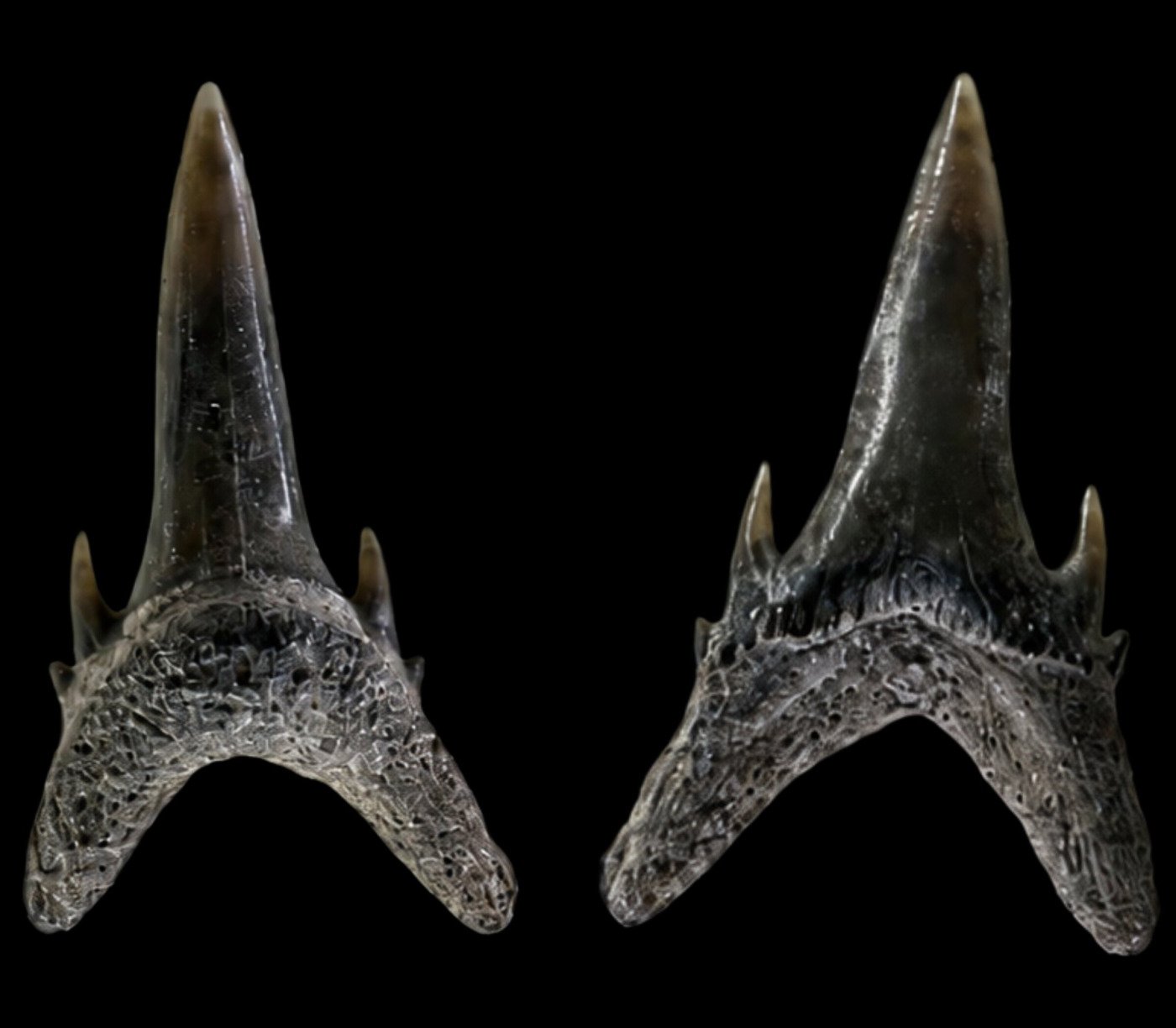
Look for: a tall smooth-edged central cusp with small lateral cusplets and conspicuous vertical striations on the lingual crown face, especially toward the base, above a divided root.
Diagnostic Features
- Principal cusp is tall, slender and sharply pointed.
- Lingual crown face commonly carries strong longitudinal striations.
- Small pointed lateral cusplets occur on complete teeth.
- Cutting edges are smooth and lack serration.
- Root is strongly bilobed with a pronounced central nutritive region.
Fossil Details
Similar Species
Recorded Fossil Sites
Beltinge Fish Bed
Lessness Shell Bed
London Clay Formation
Reculver Sand Member
Walton Member
References
- Casier, E. (1966). Faune ichthyologique du London Clay. 496 pp.. Trustees of the British Museum (Natural History), London View reference
- Dineley, D. & Metcalf, S. (1999). Fossil Fishes of Great Britain. Geological Conservation Review Series, 675 pp.. Joint Nature Conservation Committee, Peterborough View reference
- Rayner, D.; Mitchell, T.; Rayner, M. (2009). London Clay Fossils of Kent and Essex. 228 pp.. Medway Fossil and Mineral Society, Rochester, Kent View reference
- Ward, D.J. (1978). The Lower London Tertiary (Palaeocene) succession of Herne Bay, Kent. Report of the Institute of Geological Sciences. Institute of Geological Sciences View reference
- Ward, D.J. (1980). The distribution of sharks, rays and chimaeroids in the English Palaeogene. Tertiary Research, 3(1), 13–19 View reference