
Simplicioceras centrale
Simplicioceras centrale
View age-specific evidence and explanation
| Age | Recorded Occurrences | Localities | Rarity |
|---|---|---|---|
| Ypresian | 2 | 2 | Not yet established |
These counts describe published LBPS Occurrence records with directly assigned, unambiguous geological-unit mappings—not specimen abundance. Records at restricted Localities and ambiguous or unsupported ages are excluded. Species-level age labels are not used as proof of an age-specific Occurrence.
Specimen-based rarity requires comparable, correctly identified physical fossils, geological provenance and publication permissions. It does not estimate your chance of finding a fossil or collecting access.
Representative Specimens
Selected reference specimens illustrating this species from different geological units and fossil sites.
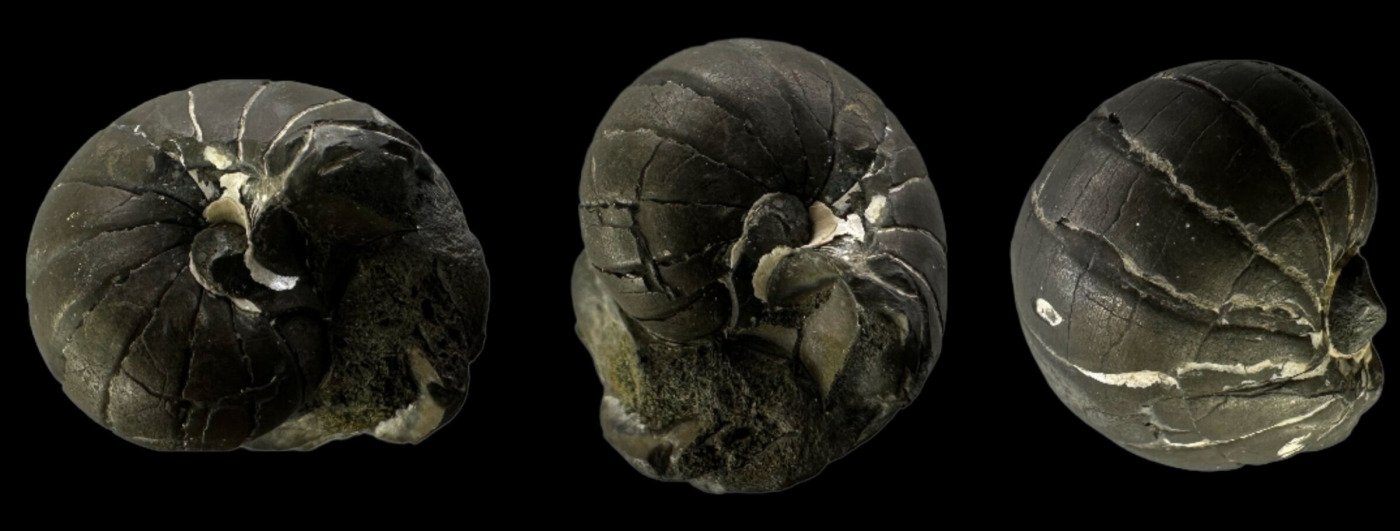
Quick Identification
Look for: a smooth, tightly coiled nautilus with a rounded ventricose whorl, narrow deep umbilicus and comparatively simple concave to gently sinuous chamber sutures.
Identification Examples
Choose a fossil site to view photographed reference specimens.
Summary
Simplicioceras centrale was a rounded chambered cephalopod that lived in the Eocene seas represented by the London Clay. The chambers inside its coiled shell controlled buoyancy, while the animal occupied the outermost body chamber and could move through the water by jet propulsion.
Its feeding behaviour is not directly preserved. Like other nautiloids it was probably a predator and scavenger, taking small animal prey and carrion. Its smooth, rounded shell shows that London Clay nautiloids were not all built alike: this form was more compact and evenly rounded than the sharper-profiled Deltoidonautilus.
Diagnostic Features
- Shell is strongly involute, with earlier whorls largely concealed.
- Whorl is rounded and ventricose rather than sharply compressed.
- Umbilicus is narrow and relatively deep.
- Septal sutures are simple to gently sinuous rather than strongly zig-zag.
- Shell surface is largely smooth apart from growth lines.
Fossil Details
Similar Species
Recorded Fossil Sites
London Clay Formation
Synonyms & Previous Names
References
- Edwards, F. E. (1849). A monograph of the Eocene Mollusca, or descriptions of shells from the older Tertiaries of England. Part I. Cephalopoda. Palaeontographical Society Monograph, 2, 1–56. Palaeontographical Society, London View reference
- Hewitt, R. A. (2002). A review of the Early Eocene nautiloids of the London Clay Formation (upper division C to lowest division E) of south-east England, with particular reference to concretionary horizons and faunules in the offshore facies strata at Southend-on-Sea, Essex and in the adjacent cliffs of the Isle of Sheppey, Kent. Tertiary Research, 21(1–4), 39–50 View reference