Zanthopsis leachii
Zanthopsis leachii
Representative Specimens
Selected reference specimens illustrating this species from different geological units and fossil sites.
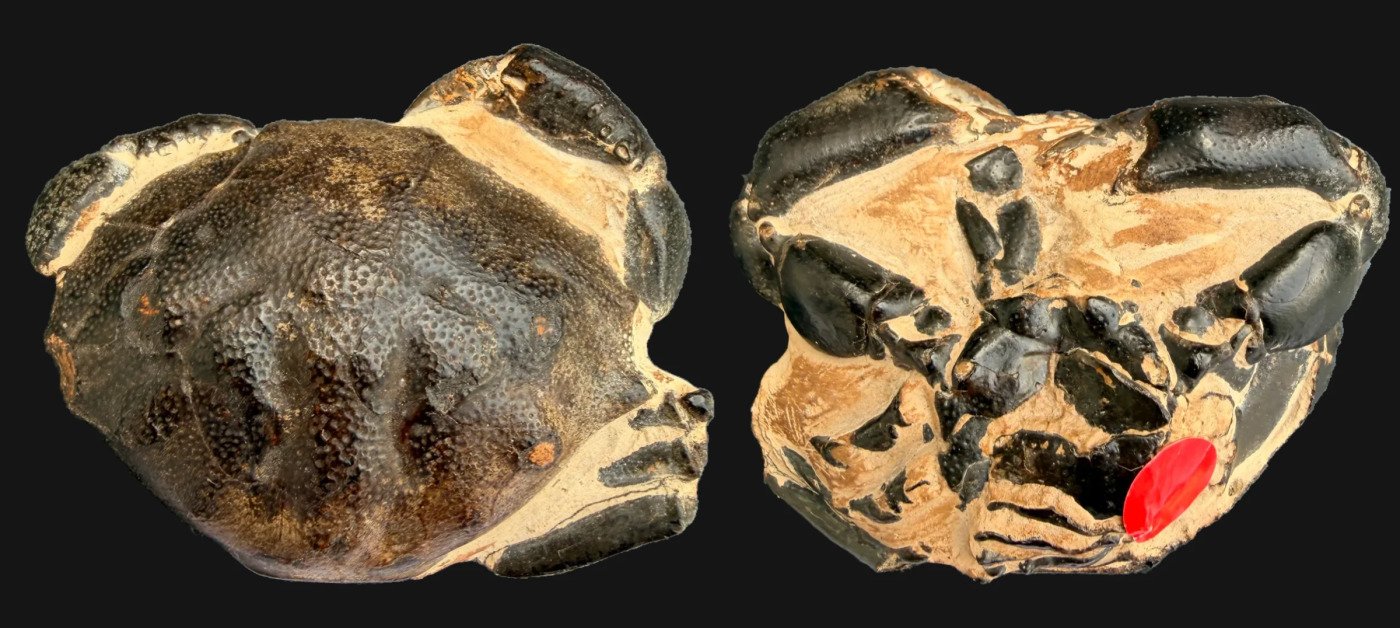
Identification Examples
Choose a fossil site to view photographed reference specimens.
Summary
Zanthopsis leachii was one of the large, robust crabs of the London Clay sea. Its heavily built carapace and powerful claws suggest a bottom-dwelling animal capable of tackling a wide range of food, from small invertebrates to carrion and possibly hard-shelled prey.
A crab of this size would have been an important mid-level predator and scavenger. Its armour offered protection, but the London Clay sea also contained large fish, sharks and rays, so even a substantial crab lived in an ecosystem full of animals capable of preying on it.
Quick Identification
Look for: a large, broad and robust Zanthopsis carapace with pronounced dorsal regions and strong marginal ornament; compare spination and nodulation with Z. nodosa, Z. dufouri and Z. unispinosa.
Diagnostic Features
- Carapace broad, robust and strongly calcified.
- Dorsal gastric, cardiac and branchial regions are prominently expressed.
- Lateral margins carry strong ornament and projections.
- Overall surface is sculptured but not dominated by the nodules of Zanthopsis nodosa.
- Species-level identification requires the full pattern of regions, margins and sculpture.
Fossil Details
Similar Species
Recorded Fossil Sites
London Clay Formation
Walton Member
Synonyms & Previous Names
References
- J. S. H. Collins; C. J. T. Mellish; A. J. Ross; P. R. Crabb; S. K. Donovan. (2020). A guide to the fossil Decapoda (Crustacea: Axiidea, Anomura, Brachyura) of the British Isles. Proceedings of the Geologists' Association, 131(1), 19–50 View reference
- Thomas Bell. (1857). A monograph of the fossil malacostracous Crustacea of Great Britain. Part I. Crustacea of the London Clay. Monograph of the Palaeontographical Society, 10, i–viii, 1–44. Palaeontographical Society, London View reference