Odontaspis winkleri
Odontaspis winkleri
Representative Specimens
Selected reference specimens illustrating this species from different geological units and fossil sites.
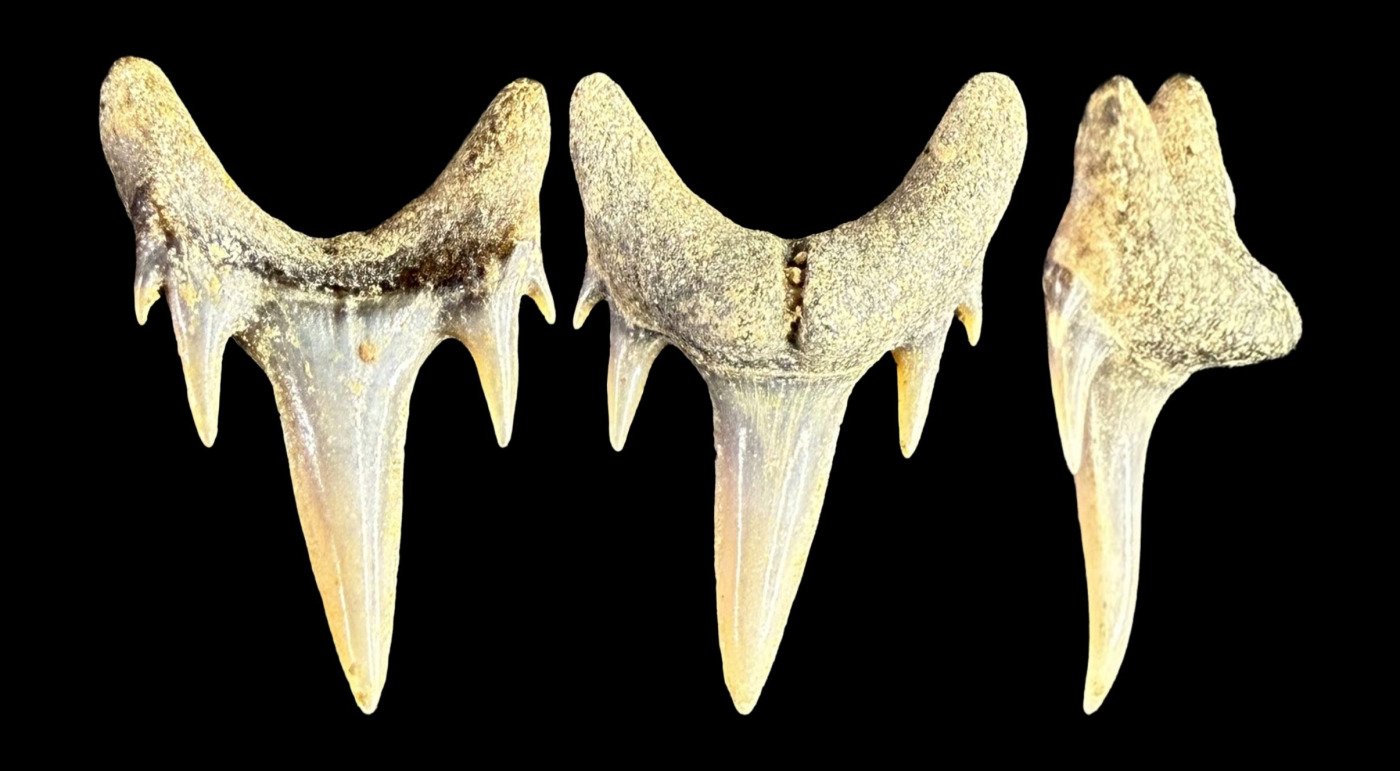
Identification Examples
Choose a fossil site to view photographed reference specimens.
Summary
Odontaspis winkleri was a sand-tiger-type shark with a dentition dominated by long, narrow grasping teeth. It was an active marine predator adapted to capturing prey that could be seized and swallowed rather than crushed.
Fishes were probably the main prey, while cephalopods and other soft-bodied animals may also have been taken. Teeth from different parts of the jaw varied in height and width, giving the mouth a combination of long front teeth for initial capture and shorter lateral teeth for holding and processing prey.
Like many fossil lamniforms, the species is known much better from its teeth than from its skeleton. Those teeth nevertheless provide a strong picture of its feeding role as a specialised predator of mobile marine animals.
Quick Identification
Look for: a long, narrow tooth with a very sharp central point and one or two smaller pointed projections on each side. The side points can be unusually tall and thin. Underneath, the root divides into two long narrow branches.
Diagnostic Features
- Main cusp is long, slender and sharply pointed, especially in anterior teeth.
- Inner lateral cusplets are unusually tall, narrow and cylindrical, sometimes accompanied by a much smaller outer pair.
- Cutting edges on anterior teeth are incomplete and stop before reaching the crown base.
- Main crown is largely smooth; some lateral teeth develop short folds restricted to the labial base.
- Root divides into two long narrow lobes separated by a central nutritive groove, producing a broad U-shaped outline.
Fossil Details
Similar Species
Recorded Fossil Sites
London Clay Formation
References
- Casier, E. (1966). Faune ichthyologique du London Clay. 496 pp.. Trustees of the British Museum (Natural History), London View reference
- Rayner, D.; Mitchell, T.; Rayner, M. (2009). London Clay Fossils of Kent and Essex. 228 pp.. Medway Fossil and Mineral Society, Rochester, Kent View reference
- Ward, D.J. (1980). The distribution of sharks, rays and chimaeroids in the English Palaeogene. Tertiary Research, 3(1), 13–19 View reference