
Pachygaleus lefevrei
Pachygaleus lefevrei
View age-specific evidence and explanation
| Age | Recorded Occurrences | Localities | Rarity |
|---|---|---|---|
| Ypresian | 5 | 5 | Not yet established |
These counts describe published LBPS Occurrence records with directly assigned, unambiguous geological-unit mappings—not specimen abundance. Records at restricted Localities and ambiguous or unsupported ages are excluded. Species-level age labels are not used as proof of an age-specific Occurrence.
Specimen-based rarity requires comparable, correctly identified physical fossils, geological provenance and publication permissions. It does not estimate your chance of finding a fossil or collecting access.
Representative Specimens
Selected reference specimens illustrating this species from different geological units and fossil sites.
Quick Identification
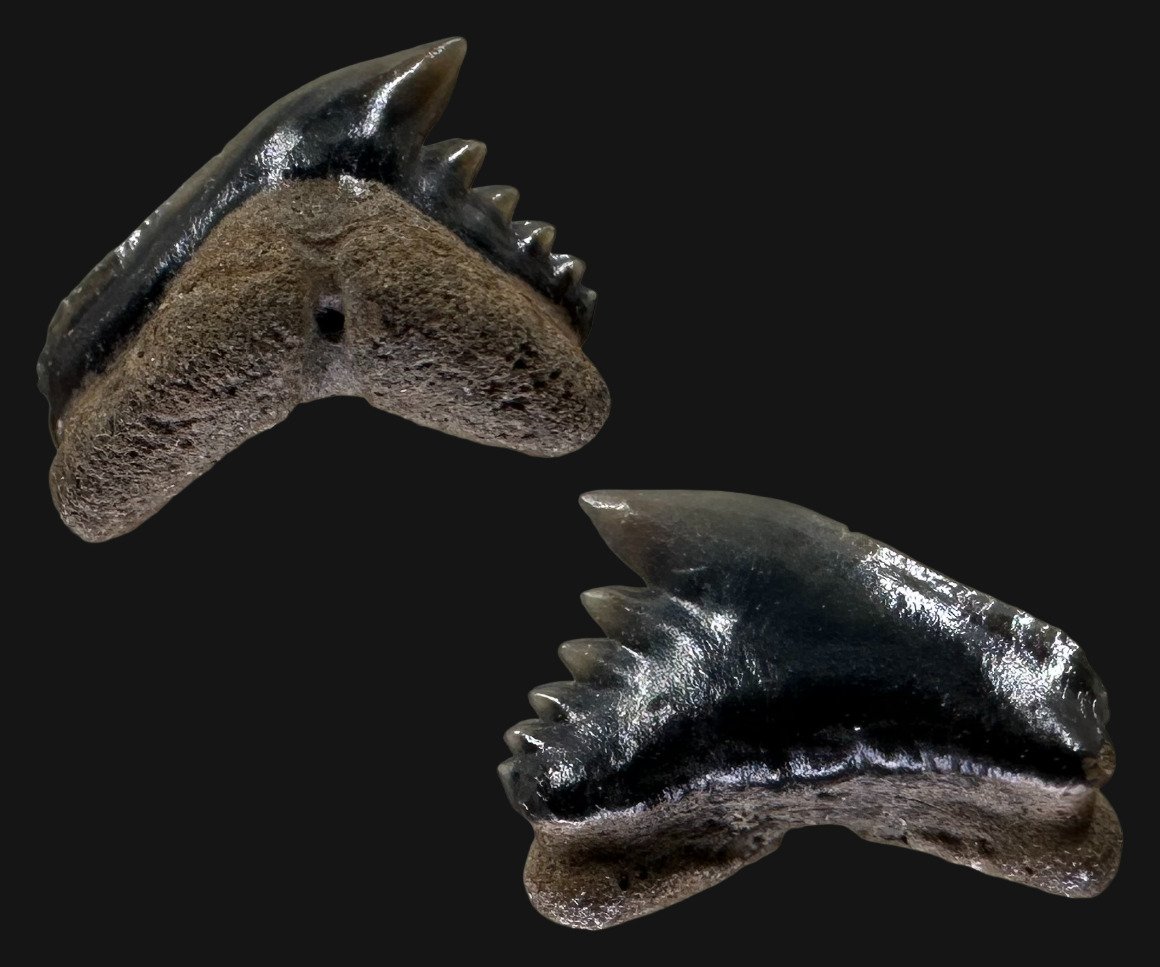
What to look for: Look for a shark tooth that is wider than it is tall and noticeably thick from its outer to inner face. Its main point leans to one side. Behind that point, the lower shoulder of the crown (the distal heel) is relatively long and commonly carries several small points, or cusplets, which get smaller towards the end. The outer crown base may project over the root.
Useful check: Examine the row of small points first, then turn the tooth over. On a complete specimen, the root divides into two rounded branches separated by a shallow U-shaped gap. A broad groove may be visible on the inner face of the root. Hold the tooth edge-on to judge how thick the crown really is.
How to tell it apart: Compared with Galeorhinus ypresiensis, Pachygaleus lefevrei generally has a thicker crown and a broader U-shaped gap between the root branches. Both can have a leaning main point and small heel teeth, so their number alone cannot decide the species. Compare teeth from similar positions in the jaw whenever possible.
Be careful: Teeth towards the front and sides of a jaw differ. If the long heel has broken, several small points may be missing; a broken root can hide the other useful difference. An incomplete tooth may not support a secure species identification.
Identification Examples
Choose a fossil site to view photographed reference specimens.
Summary
Not every shark in Eocene seas was a sand tiger. Pachygaleus lefevrei belonged to the hound-shark side of the shark family tree, and its teeth reveal a mouth built on a noticeably different plan. Instead of the long, spear-like teeth familiar from many fossil lamniforms, Pachygaleus carried relatively broad, thick teeth whose form changed around the jaw.
Its fossils also reveal a surprisingly wide-ranging lineage. Teeth referred to P. lefevrei occur in western Europe and North America, while the wider Palaeogene record shows that hound sharks were once more diverse across the North Atlantic region than a casual look at modern faunas might suggest. The genus Pachygaleus itself was eventually created because these teeth were sufficiently unlike those of the hound-shark genera into which palaeontologists had previously tried to fit them.
We still cannot responsibly tell a visitor the exact size of P. lefevrei or list its prey. What we can say is more interesting than simply filling those gaps with guesses: this was a distinct Eocene hound-shark lineage, recognisable from a feeding apparatus unlike the toothy sand-tiger sharks swimming in the same broad geological world, and one that palaeontologists needed more than a century of collecting and comparison to recognise on its own terms.
Diagnostic Features
- Overall proportions: Teeth are mesiodistally wider than tall and labiolingually thick; the labial crown foot overhangs the root.
- Main cusp: Main cusp is distally directed, with an elongated convex mesial cutting edge and a much shorter distal edge. The mesial edge is usually unserrated, although occasional serration has been documented.
- Distal heel: Distal heel is elongated and bears multiple distally directed cusplets that decrease in size away from the main cusp; 3–10 are reported in a modern described sample.
- Crown ornament: Crown enameloid is generally smooth. Short longitudinal folds may occur near the labial crown base in extreme lateral or juvenile teeth, so absence of ornament must not be treated as an absolute character.
- Root: Root is thick and bilobate, with widely diverging rounded lobes, a shallow U shaped interlobe area and a wide lingual nutritive groove containing a central foramen.
- Differential and identification limit: Species identification should use the character combination rather than cusp inclination or cusplet number alone. Compared with Galeorhinus, particularly useful characters include greater labiolingual crown thickness and the broader U shaped interlobe area; distal cusplet counts overlap between taxa.
Fossil Details
Similar Species
Recorded Fossil Sites
London Clay Formation
Diagnostic Sources
- Adnet, S.; Cappetta, H. (2008). New fossil triakid sharks from the early Eocene of Prémontré, France, and comments on fossil record of the family. Acta Palaeontologica Polonica, 53(3), 433–448 View reference
- Cappetta, H. (1992). Carcharhiniformes nouveaux (Chondrichthyes, Neoselachii) de l’Yprésien du Bassin de Paris. Geobios, 25(5), 639–646 View reference
- Case, G.R.; Cook, T.D.; Wilson, M.V.H. (2015). A new elasmobranch assemblage from the early Eocene (Ypresian) Fishburne Formation of Berkeley County, South Carolina, USA. Canadian Journal of Earth Sciences, 52(12), 1121–1136 View reference
- Daimeries, A. (1891). Notes ichthyologiques – VI. Annales de la Société royale malacologique de Belgique, Bulletin des Séances, 26, 73–77 View reference
- Ebersole, J.A.; Cicimurri, D.J.; Stringer, G.L. (2019). Taxonomy and biostratigraphy of the elasmobranchs and bony fishes (Chondrichthyes and Osteichthyes) of the lower-to-middle Eocene (Ypresian to Bartonian) Claiborne Group in Alabama, USA, including an analysis of otoliths. European Journal of Taxonomy, 585, 1–274 View reference
References
- Adnet, S.; Cappetta, H. (2008). New fossil triakid sharks from the early Eocene of Prémontré, France, and comments on fossil record of the family. Acta Palaeontologica Polonica, 53(3), 433–448 View reference
- Cappetta, H. (1992). Carcharhiniformes nouveaux (Chondrichthyes, Neoselachii) de l’Yprésien du Bassin de Paris. Geobios, 25(5), 639–646 View reference
- Ebersole, J.A.; Cicimurri, D.J.; Stringer, G.L. (2019). Taxonomy and biostratigraphy of the elasmobranchs and bony fishes (Chondrichthyes and Osteichthyes) of the lower-to-middle Eocene (Ypresian to Bartonian) Claiborne Group in Alabama, USA, including an analysis of otoliths. European Journal of Taxonomy, 585, 1–274 View reference